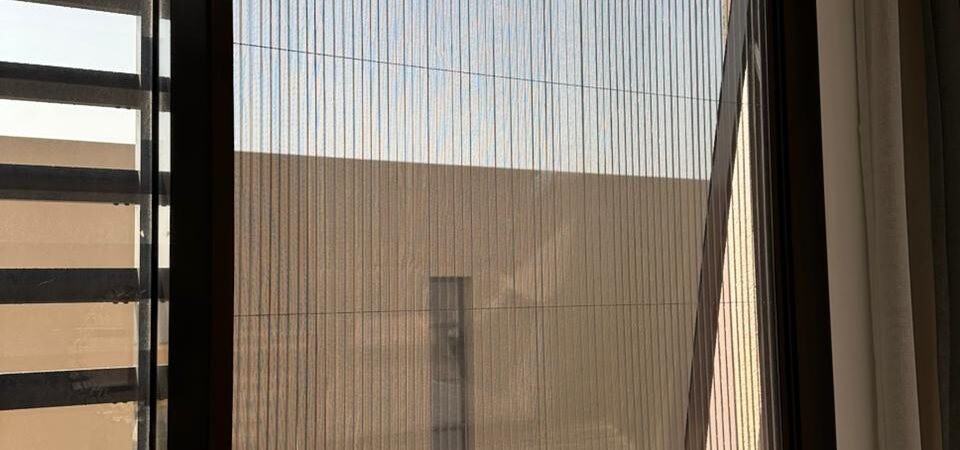
Most people never clean their insect screens. Then one summer they notice the room feels stuffier than it used to, the view through the window has gone slightly grey, and they conclude the screen is the problem. Usually the screen is fine. It is just full of Dubai.
A mosquito screen is a filter you never intended to install. Every bit of airborne dust that blows against your window gets caught in a weave with roughly 1.2 mm openings, and in this city a lot blows against your window. Left long enough, the mesh stops being a screen and starts being a blanket.
This is the method we give our own customers, the honest schedule, the things that destroy mesh faster than dust ever will, and how to tell when cleaning is no longer the answer.
- 784Micrograms of PM10 per cubic metre recorded in Dubai during the May 2022 sandstorm
- 3Months between cleans that manufacturers recommend for coastal homes
- 8-12Years of life from fibreglass mesh in a coastal climate, if you look after it
The six steps
Why screens clog faster here than almost anywhere
Three things happen to a screen in the UAE that do not happen in most places, and they happen at the same time.
Dust, constantly and then catastrophically. There is a background level of fine dust in the air here all year, and then there are the events. During the sandstorm that hit the region in May 2022, air quality monitoring put Dubai’s city-wide PM10 at 784.7 micrograms per cubic metre and PM2.5 at 94.5, which is roughly nineteen times the World Health Organization’s annual guideline. A single day like that puts more into your mesh than a European screen collects in a year, and monitoring groups note that sandstorm frequency in the region is rising rather than falling.
Salt, if you are anywhere near the water. Coastal air carries salt that settles on aluminium frames and fixings and slowly corrodes them. This is why manufacturers quote shorter service lives for coastal installations than for inland ones, and why the cleaning interval they recommend near the sea is four times shorter.
Water, from the one appliance that never stops. Your AC produces litres of condensate a day for half the year. Where that drips or drifts onto a dusty screen you get a paste rather than a powder, and paste does not blow off. It sets. Screens near a condensate outlet or an outdoor unit are reliably the dirtiest ones in any home we visit.
Put together, that is why the honest answer to “how often should I clean it” is different here than the answer you will find on an Australian or British cleaning blog.
How often, honestly
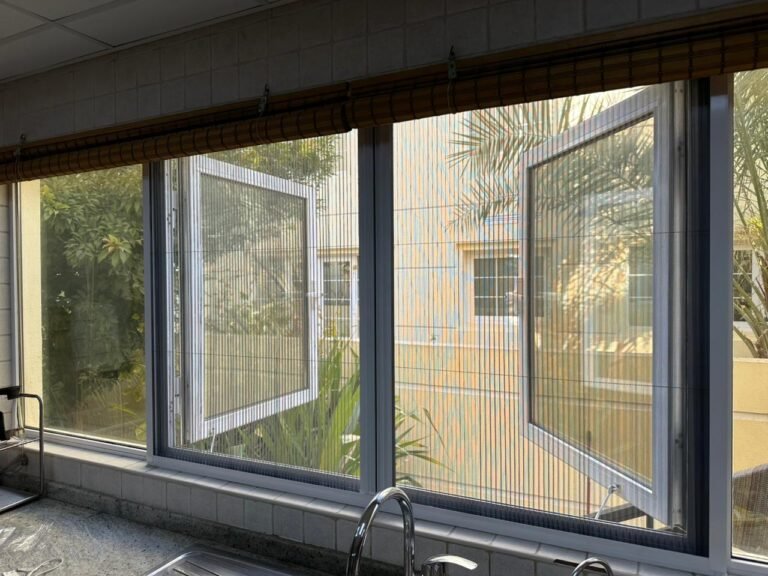
Andersen, one of the larger window manufacturers, tells owners to clean insect screens at least once a year, and every three months in coastal, industrial or agricultural areas. Most of Dubai, Abu Dhabi and Sharjah is coastal. That puts the baseline at quarterly, not annual.
In practice, this is what we suggest:
| Situation | How often | Why |
|---|---|---|
| Coastal apartment or villa | Every 3 months | Salt plus dust; the manufacturer interval |
| Inland, away from construction | Every 6 months | Dust only, and less of it |
| Next to active construction | Every 6-8 weeks | Cement dust is abrasive and sets hard |
| Screen beside an AC outdoor unit | Every 2-3 months | Condensate turns dust into paste |
| After any sandstorm | Within a week | Before humidity binds it into the weave |
| Before you open up for winter | October or November | The screens are about to work hard |
The October clean is the one most worth putting in a calendar. From November to March every window in the UAE is open, which is exactly the stretch when a clogged screen is most annoying and when mosquitoes are most able to walk in through a gap you have not noticed.
The six-step method that will not wreck the mesh
None of this is difficult. The order matters more than the effort, and step two is the one almost everyone skips.
1Take the panel out, if it comes out
A removable panel cleaned flat on the floor gets properly clean. A panel cleaned in place gets the dirt pushed into the bottom rail and the window behind it soaked.
Most fixed and sliding window screens lift out. Pleated and retractable systems generally do not, and should not be forced; clean those in place and see the system notes further down. If a panel resists, stop. Plastic clips go brittle in UV and snap rather than flex.
Worth doing: photograph the panel in its frame before you remove it. Screens are handed, and the number of people who refit one upside down and then decide it is faulty is higher than you would think.
2Get the dry dust off first
This is the step that decides whether you are cleaning the screen or grinding grit into it. Dry dust brushes off. Wet dust becomes mud and gets driven into the weave, and the silica in desert sand is hard enough to abrade a vinyl mesh coating if you scrub it in.
Use a vacuum with the soft brush attachment on both faces, working in one direction with the lightest contact that still lifts dust. No vacuum to hand? A dry soft-bristle brush or a microfibre cloth will do most of it.
Worth doing: hold a sheet of cardboard behind the panel while you vacuum. It gives the mesh something to push against so it does not stretch away from the brush, and it keeps the dust out of the room.
3Mild soapy water and a soft brush
Manufacturer guidance is consistent and unexciting: mild soapy water and a soft-bristle brush. A few drops of washing-up liquid in warm water is exactly right. Nothing stronger is needed, and most things stronger do damage.
Work in small sections with light pressure, brushing along the weave rather than circling. Stainless steel mesh will take a firmer hand than fibreglass; fibreglass is a glass fibre with a vinyl coating, and the coating is the part that keeps it flexible. Scour that off and the mesh goes brittle years early.
4Rinse properly, then dry it
Soap left in a weave is sticky, and sticky mesh collects the next week’s dust faster than clean mesh does. Rinse with low-pressure clean water until the run-off is clear.
Then dry it. Refitting a wet panel into an aluminium frame traps moisture against the fixings, which in coastal air is how corrosion starts. A soft cloth and ten minutes stood on edge in the shade is enough. Not in direct Gulf sun, which bakes any remaining mineral deposits into spots.
5The track and the frame
With the panel out, the track is accessible for the only time all year, and the track is where sliding and pleated systems actually fail. Vacuum it, wipe it, and get the compacted grit out of the corners with a dry brush.
Do not grease it. Oil and grease in a Dubai track collect dust and set into a paste that is far worse than the original friction. If a track genuinely needs lubrication, a dry PTFE spray is the only sensible option, used sparingly.
Worth doing: while the frame is bare, run a finger along the fixings. Any white powdery bloom on aluminium is early corrosion, and it is far cheaper to deal with then than after a fixing seizes.
6Check the perimeter before you refit
Cleaning is the natural moment to do the inspection Dubai Municipality asks residents to do anyway: its public guidance on mosquito control tells people to check window screens for damage, alongside clearing standing water.
What you are looking for is not the obvious hole in the middle. It is the edge. Hold the panel up to the light and look along all four sides. A 3 mm gap where the spline has lifted, a corner that no longer sits flat, a bottom rail that has dropped a few millimetres out of square: those are what let mosquitoes in, and a perfect mesh with a bad perimeter stops nothing.
What actually kills screens, and none of it is dust
We replace a lot of mesh that failed years early. Almost none of it failed because nobody cleaned it. It failed because somebody cleaned it badly.
- Pressure washers. The single most destructive thing you can point at an insect screen. A jet strong enough to lift set dust will stretch the mesh out of tension, blow the spline out of its groove, or put a hole straight through. There is no safe setting; use a hose at ordinary pressure.
- Bleach, solvents and bathroom cleaners. They attack the vinyl coating on fibreglass and the anodising on aluminium frames. The mesh may look brighter for a month and then start going chalky and stiff.
- Scouring pads and stiff brushes. Same problem, applied mechanically. Soft bristles only.
- Cleaning dry dust with water. Covered above, and worth repeating because it is the most common mistake: wetting first turns abrasive grit into grinding paste.
- Drying in direct sun. Bakes mineral residue into the weave and accelerates UV damage to the coating, which is already the thing that ends a fibreglass screen’s life.
- Grease in the track. Turns a smooth slider into a gritty one within a season.
Almost every screen we replace early was killed by a pressure washer, not by neglect.
Clean it, re-mesh it, or replace it?
The useful thing to know is that the frame almost always outlives the mesh. Screen manufacturers put the gap at roughly five to ten years, which is why replacing just the mesh in a sound frame is usually the sensible repair rather than buying a new unit.
| What you are looking at | What it needs |
|---|---|
| Grey, dull, airflow noticeably reduced | A clean. This is 90% of cases |
| Stains that will not shift but mesh still flexible | A clean. Cosmetic, not functional |
| Mesh stiff, chalky, or snapping when flexed | Re-mesh. The coating has gone |
| A tear, a hole, or a pet-sized opening | Re-mesh. Patches never hold in this heat |
| Mesh sagging or bellying out of the frame | Re-mesh. The tension is gone |
| Spline lifted along one edge, mesh fine | Re-spline, a small job |
| Frame bent, corners split, or badly corroded | Replace the unit |
| Fixings seized or the frame no longer square | Replace the unit |
If you are re-meshing anyway, it is the one moment when changing the weave costs you nothing extra in labour. People who found their screen too dark often want a more open weave; people fighting sandflies or with cats usually want the opposite. Our guide to mosquito mesh types sets out what each weave trades away.
How long should a screen last in the UAE?
Published manufacturer lifespans are based on temperate and US coastal conditions. UAE sun and dust are harsher than that, so treat these as the optimistic end rather than a promise.
| Material | Quoted life | What ends it |
|---|---|---|
| Fibreglass mesh | 8-12 years coastal; 7-10 on a hot south or west elevation | UV breaking down the vinyl coating until fibres go brittle |
| Aluminium mesh and frames | 10-20 years; coastal corrosion can appear at 12-15 | Salt air; replace at the first real sign of rust |
| Pet-resistant mesh | 12-18 years with pets in the house | UV, eventually; it resists tearing well |
| Solar and shade mesh | 10-15 years, more with added UV inhibitors | UV; density and colour make little difference |
| Stainless steel mesh | Longest of the lot | Specified for genuinely corrosive settings. See stainless mesh |
The variable you control is cleaning. Trapped dust and salt sit against the coating and work on it continuously, so the screen that gets rinsed four times a year genuinely outlasts the identical screen next door that never does.
Notes for each system
Pleated screens
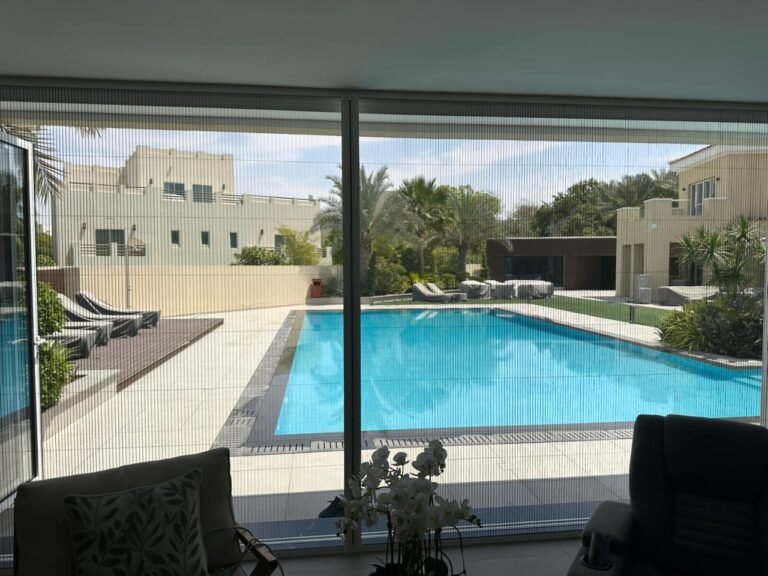
Do not remove the panel and do not soak the pleats. Draw the screen closed, vacuum both faces gently, then wipe with a barely damp cloth following the pleat lines rather than across them. The bottom track matters more than the mesh on these: grit in the track is what makes a pleated screen feel notchy. Vacuum it monthly and the system stays smooth for years.
Retractable and roll-up screens
Never roll a dirty screen away wet. Dust and moisture wound into a cassette is how the spring mechanism in a retractable screen ends up jamming, and a cassette is the hardest part of any system to service. Draw it fully out, clean it, let it dry completely, then retract. Wipe the guide channels at the same time.
Sliding and fixed window screens
These are the easy ones, and the ones the six steps above were written for. Panels lift out, clean flat and refit in minutes. If a sliding screen has started catching, the cause is nearly always the track rather than the rollers. Most window screens in UAE homes are in this group.
Magnetic door screens
The mesh on a magnetic screen is usually washable, but the thing to clean is the magnet strip. Dust and hair on the magnets stop the two halves closing fully, which leaves a vertical slot down the middle of your door screen that you will not notice until something flies through it. Wipe the strip whenever you clean the mesh.
After a sandstorm: the twenty-minute reset
Humidity is what turns a dusting into a crust, so the window to act is short. Within a few days of a storm:
- Vacuum every screen dry, inside and out. Do not wet anything yet.
- Rinse with a hose at normal pressure from the outside, top down.
- Leave everything to dry in shade before closing or retracting anything.
- Vacuum the tracks, where most of the storm actually ended up.
- Check the AC condensate outlet nearby, because storm dust plus condensate is the combination that sets hardest.
Twenty minutes for a flat. It is the difference between mesh that rinses clean and mesh you end up replacing.
Frequently asked questions
Can I pressure wash my fly screens?
No. It is the most common way screens get destroyed. Pressure high enough to shift baked-on dust will stretch the mesh, force the spline out of its groove or punch through the weave. A garden hose at ordinary pressure, after dry vacuuming, does the job without the risk.
How often should I clean mosquito screens in Dubai?
Every three months if you are near the coast, which most of Dubai is, and every six inland. Manufacturers specify quarterly cleaning for coastal, industrial and agricultural areas. Add an extra clean after any sandstorm and one in October before the windows start staying open.
My screen blocks the airflow. Is that normal?
A clean screen costs you some airflow, and that is unavoidable physics. A noticeable drop usually means the mesh is clogged rather than that the weave is wrong. Clean it first. If airflow is still poor afterwards, the weave may genuinely be too dense for that opening, and a more open mesh at the next re-mesh will fix it.
Can a torn mosquito net be repaired, or does it need replacing?
If the frame is straight and the corners are sound, the mesh alone gets replaced and the frame stays. Frames typically outlast mesh by five to ten years, so re-meshing is the normal repair. Patch kits and adhesive tape do not survive UAE heat and tend to peel within a season.
What is the white powder on my screen frame?
Aluminium oxidation, usually from salt air. Early on it wipes off and the frame is fine. Once it has pitted the surface or the fixings have seized, the frame is near the end of its life and replacement makes more sense than repair.
Will cleaning make the mesh last longer?
Yes, measurably. Trapped dust and salt hold moisture against the coating and abrade it in the wind. Removing them regularly is the one maintenance step that extends service life, which is why manufacturers put cleaning intervals in their care guidance rather than leaving it to preference.
When it is worth calling someone
Cleaning is a job for you, and we would rather tell you that than sell you a visit you do not need. Call someone when the mesh has gone brittle or torn, when the spline has come out along a run, when a retractable cassette has jammed, when a frame is corroded or out of square, or when the screens are on a high-rise elevation you cannot safely reach.
We re-mesh existing frames as well as supplying new screens, including units other companies fitted, and in most cases a re-mesh costs a fraction of a replacement. More answers on care and warranty are in our FAQs, and if you are not sure which category yours falls into, send a photo through the contact page and we will tell you honestly whether it needs us or a bucket.
Worth knowing too: a screen in poor condition is not just a tidiness problem. Mosquitoes find a lifted edge long before they find a hole, which is the same lesson that runs through our guide to how mosquitoes get into a Dubai apartment.
Sources
- Andersen Windows, Clean your insect screen’s mesh and frame, on cleaning method and intervals.
- RiteScreen, How long do window screen materials last, on material lifespans and frame-versus-mesh economics.
- IQAir, Air quality scientists worried about sandstorm, on Dubai PM10 and PM2.5 readings during the May 2022 event.
- Dubai Municipality: top tips to combat mosquito proliferation after rainfall, Gulf News, on inspecting window screens for damage.
- World Health Organization, Dengue and severe dengue, on window screens as a recommended household measure.