You get bitten on the balcony at seven in the evening. Someone else in the same building gets bitten in bed at three in the morning. A third person swears there are no mosquitoes at all in their villa two streets away. All three of you are right, because you are not dealing with the same insect.
Ten mosquito species were caught in the largest published survey of mosquitoes in the UAE. Most of them will never touch you. Three of them account for almost everything a person living in Dubai, Abu Dhabi, Sharjah or Ras Al Khaimah will actually experience, and knowing which one is biting you tells you three useful things at once: what time you are vulnerable, where the water it came from is sitting, and whether a screen will fix it.
This is a field guide, not a pest-control sales pitch. We fit insect screens for a living, so we see the aftermath of all three of these mosquitoes in people’s homes every week. Here is who they are.
The short version
- Bitten indoors, at night, while asleep? Almost certainly Culex quinquefasciatus, the southern house mosquito.
- Bitten outdoors at dusk, especially near the coast, creeks or mangroves? Almost certainly Aedes caspius, the salt-marsh mosquito.
- Seeing swarms but not getting bitten much? Probably Culex perexiguus, the most abundant mosquito in the country, which prefers birds.
- Bitten in the middle of the day, indoors, in an urban apartment? Worth paying attention to. That is Aedes behaviour, and Aedes aegypti is the species UAE health authorities are now watching.
1. Culex quinquefasciatus: the one biting you indoors at night
If you wake up at 3am with bites on an ankle and an arm and you can hear a thin whine near your ear, this is the one. The southern house mosquito is one of the most successful urban mosquitoes in the world. It has followed people into warm cities on every continent, and it thrives in the UAE because we give it exactly what it wants: warm, still, nutrient-rich water, and buildings it can walk into.
How to know it is Culex quinquefasciatus
- Appearance: a plain, dull-brown mosquito with no stripes or white markings on its legs. Genuinely boring to look at, which is itself the identifying feature.
- Timing: active in the evening, through the night and into early morning. It is a nocturnal feeder.
- Location: indoors. Texas A&M’s mosquito reference describes it entering homes “through unscreened windows or open doors” to bite people who are resting.
- Range: it rarely flies more than about 1.5 km from where it hatched. If this mosquito is biting you, the water it grew up in is close to your building.
Where it breeds around a UAE home
This species does not need clean water. It prefers the opposite: organically rich, stagnant, slightly foul water. Around a typical UAE property that means blocked floor drains and gully traps, uncovered or cracked septic tanks, the tray under a split-AC unit, disused swimming pools and water features, standing water in a plant saucer or a discarded paint tin on a rooftop, and irrigation boxes that never fully drain.
The turnaround is fast. A female lays a raft of a hundred or more eggs at a time, those eggs hatch within about 24 to 30 hours, larvae complete development in five to eight days at 30 °C, and the pupal stage takes roughly a day and a half. In UAE summer temperatures you are looking at roughly a week from a puddle appearing to adults flying out of it.
Why fogging is not working as well as it used to
This is the part most people have not heard. A 2025 study in Scientific Reports tested Culex quinquefasciatus collected from sixteen locations across Abu Dhabi in 2023. Full deltamethrin resistance showed up in only one of the eight populations tested by bioassay, which sounds reassuring. The genetic picture is less so: the kdr L1014F mutation, the mutation that confers knockdown resistance to pyrethroids, was found at every single sampled location. Fully resistant genotypes made up 18.4% of samples overall, rising to 25.7% in coastal areas.
Practically, that means the resistance is already seeded and spreading, and the chemical layer of mosquito control is a depreciating asset. Physical exclusion is not. A mesh does not become less effective because a mosquito population evolved.
2. Aedes caspius: the salt-marsh mosquito that travels to find you
This is the mosquito that ruins outdoor evenings, and it is the reason the “but there is no standing water anywhere near my villa” argument does not hold. Aedes caspius is a salt-marsh species. It breeds in brackish and saline water: coastal pools, mangrove edges, salt flats, sabkha, and the wetted margins of tidal creeks.
In the UAE survey, it was the dominant species at Ras Al Khor Wildlife Sanctuary in Dubai, a 620-hectare brackish wetland where treated municipal water mixes with seawater at the head of Dubai Creek. That sanctuary sits directly beside dense residential Dubai. The same kind of brackish habitat runs along the Sharjah and Umm Al Quwain lagoons, Khor Al Beidah, and the creek systems of Ras Al Khaimah and Abu Dhabi.
How to know it is Aedes caspius
- Timing: the Walter Reed Biosystematics Unit notes that where it is abundant, females bite “day and night, both indoors and out”. Where numbers are lower, biting is mostly outdoors around dawn and dusk.
- Aggression: persistent and willing to bite through thin clothing. Outdoor evening events near the coast are its natural hunting ground.
- Range: this is the key one. Salt-marsh mosquitoes make long-distance flights shortly after they emerge. Your neighbourhood does not need any standing water for you to be bitten by them. The nursery can be kilometres away.
On disease, it is a nuisance biter first and foremost, though it holds the unusual distinction of being one of very few mosquitoes proven to transmit Francisella tularensis, the bacterium behind tularemia. That is not a live concern for UAE residents. The bites are.
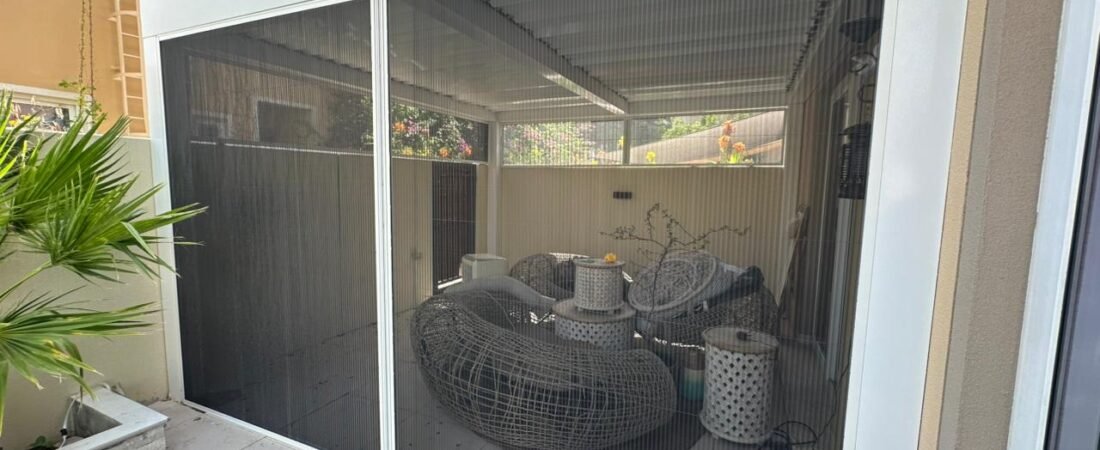
Because this species will bite outdoors in daylight as well as at dusk, it is the main argument for screening a balcony or terrace rather than only the windows. If you use the outdoor space, screened balconies and retractable screens that pull away when you want the space open are the practical answer.
3. Culex perexiguus: the country’s most abundant mosquito, and it is not after you
Here is the counter-intuitive one. The most numerous mosquito caught in the UAE survey was not either of the two above. Culex perexiguus made up 710 of the 1,142 mosquitoes trapped, or 62.1% of everything collected, and at Al Ain Zoo it accounted for nearly 90% of the catch.
You have almost certainly never been bitten by one. Culex perexiguus feeds mainly on birds. It thrives in peri-urban landscaped environments: parks, zoos, golf courses, irrigated gardens, ornamental ponds. Which is precisely why it matters.
Bird-feeding Culex mosquitoes are how flaviviruses circulate. In that same survey, two flaviviruses, Barkedji virus and Bagaza virus, were detected in Culex perexiguus pools from Al Ain Zoo, the first confirmed reports from this species in the UAE. Every other species and location tested negative. This mosquito is the country’s quiet reservoir species: high numbers, low human contact, real virological significance.
If you live beside a park, a golf course or a landscaped community lake and you see clouds of mosquitoes at dusk that somehow do not seem to bite much, this is very likely what you are looking at.
The fourth name you will start hearing: Aedes aegypti
The three above are the ones you meet. Aedes aegypti is the one to know about, because the situation is changing.
It did not appear in the 2018 trapping survey at all. In August 2026, however, the US Centers for Disease Control and Prevention’s journal Emerging Infectious Diseases published a report titled Detection of Dengue Virus in Aedes aegypti Mosquitoes, Dubai, United Arab Emirates. That is a meaningful development, and it is the reason mosquito identification in the UAE is no longer a purely academic exercise.
Aedes aegypti behaves unlike the two Culex species. The World Health Organization is blunt about the timing: “the mosquitoes that spread dengue are active during the day”. It breeds in small, clean, artificial containers rather than drains and marshes, so it lives in and around buildings: water storage containers, plant pots and saucers, roof gutters, buckets on balconies, discarded packaging. It has striking white markings on black legs and a lyre-shaped white pattern on its thorax, which makes it the most visually distinctive of the four.
Nothing here calls for alarm. It calls for the same boring, effective habits: no standing water in containers on your property, and screens on the openings you use.
Every mosquito species recorded in the UAE’s largest survey
Researchers trapped mosquitoes at three contrasting UAE sites in winter and spring 2018 using CO2-baited BG-Sentinel and CDC light traps: Al Ain Zoo (peri-urban, Al Ain), Ras Al Khor Wildlife Sanctuary (brackish wetland, Dubai) and Wadi Wurayah National Park (protected mountain wadi, Fujairah). This is the full catch.
| Species | Specimens | Where it dominated | What it means for you |
|---|---|---|---|
| Culex perexiguus | 710 | Al Ain Zoo (89.7% of catch) | Bird-feeder. Rarely bites people. Carried two flaviviruses. |
| Aedes caspius | 287 | Ras Al Khor, Dubai (62.7%) | The outdoor biter. Day and dusk, flies long distances. |
| Culex quinquefasciatus | 82 | Wadi Wurayah (50.6%) | The indoor night biter. The one in your bedroom. |
| Culex sinaiticus | 13 | Wadi Wurayah only | Wild habitat species. No household relevance. |
| Anopheles culicifacies | 10 | Al Ain Zoo only | A malaria vector elsewhere. The UAE has been malaria-free since 2007. |
| Culex tritaeniorhynchus | 8 | Al Ain Zoo only | Japanese encephalitis vector in Asia. Not a UAE concern. |
| Culiseta longiareolata | 8 | Both peri-urban and wild sites | Bird and livestock feeder. Low human contact. |
| Culex bitaeniorhynchus | 5 | Wadi Wurayah only | Breeds in algae-rich natural pools. |
| Culex laticinctus | 2 | Wadi Wurayah only | Rock-pool species. Wild habitats. |
| Anopheles stephensi | 1 | Al Ain Zoo only | The invasive urban malaria vector spreading globally. One specimen. |
Two entries deserve a note. Anopheles stephensi turned up exactly once, but it is the invasive urban malaria vector that has been spreading through the Horn of Africa and the Arabian Peninsula and is the subject of an active WHO vector alert. And Anopheles culicifacies, also present, is a malaria vector in South Asia. Their presence is not the same as disease transmission, which brings us to the honest risk picture further down.
One caveat worth stating plainly: none of the three survey sites was a residential neighbourhood. The proportions above describe a zoo, a wetland reserve and a mountain wadi, not a villa in Al Barsha. They tell you which species exist in the country and what habitat each one favours; they do not tell you the mix inside your apartment. For that, the behaviour of each species is the better guide, which is what the next table is for.
Which one bit you? A quick identification table
Work backwards from the circumstances rather than trying to identify the insect. In practice you never get a good look at it anyway.
| What happened | Most likely species | What to fix first |
|---|---|---|
| Bitten in bed, after midnight, indoors | Culex quinquefasciatus | Screen the bedroom windows; find the drain or AC tray |
| Bitten on the balcony between 6pm and 8pm | Aedes caspius | Screen the balcony or terrace opening |
| Bitten in the garden in bright daylight, near the coast | Aedes caspius | Repellent outdoors; screen the doors it follows you through |
| Bitten indoors in the middle of the afternoon | Aedes, possibly Aedes aegypti | Remove all container water; screen windows and doors |
| Swarms visible at dusk near a park or lake, few bites | Culex perexiguus | Usually nothing. It is not feeding on you |
| Bites only when the kitchen or bathroom window is open | Culex quinquefasciatus | That window is the entry point. Screen it |
Where mosquitoes actually breed around a UAE home
The UAE Ministry of Climate Change and Environment has published its own hotspot list and asks residents to report standing water or heavy mosquito activity on 8003050. The sites it names are: discarded tyres, cans and flowerpots holding water; uncovered barrels, buckets and pots; ponds, marshes, swamps and lakes; construction site pits, ditches and tanks; uncovered septic tanks; unused swimming pools and fountains; and clogged storm drains and blocked gutters.
To that list, from what we see on site visits in UAE homes specifically, add three more that people almost never think of:
- Split-AC condensate trays and drain lines. A slow drip into a blocked tray on a hot balcony is a perfect Culex nursery, and it is running all summer.
- Landscape irrigation valve boxes. Sunken plastic boxes in villa gardens hold a few centimetres of water for weeks after the system runs.
- The saucers under indoor and balcony plants. Small, clean, container water. This is exactly what Aedes wants.
After the heavy rain in the UAE in spring 2026, Dubai Municipality asked residents to clear water accumulation and fix leaks around their properties, took pest control requests through the DubaiNow app, and released larvae-eating fish into standing water. Source control is genuinely the first line, and it is free.
When is mosquito season in the UAE?
There is no true off-season here, which surprises people arriving from Europe. The UAE survey trapped mosquitoes in both winter (late January to early February) and spring (mid-April to early May), and found species active in both.
What changes is the mix and the intensity:
- November to March: the pleasant months. Windows and balcony doors are open, which is exactly when Culex quinquefasciatus walks in. Complaints peak not because there are more mosquitoes but because there are more open openings.
- After any rain event: the sharpest spike. Every one of the ministry’s hotspot containers fills at once, and roughly a week later the adults emerge. The spring 2026 rains produced exactly this pattern across UAE communities.
- June to September: ferocious heat suppresses outdoor activity, but the humid coastal strip and irrigated areas keep breeding going, and AC condensate keeps supplying water even when nothing else does.
How much disease risk is there, honestly?
Low, and worth being calm and accurate about.
Malaria: the UAE was certified malaria-free by the World Health Organization in 2007, among the first countries in the Eastern Mediterranean Region to achieve it, and has held that status since. Anopheles mosquitoes are present, as the survey shows, but the transmission cycle is not.
Dengue: the CDC’s August 2026 report of dengue virus detected in Aedes aegypti in Dubai is the reason surveillance has tightened. WHO’s practical advice for dengue prevention lists window screens explicitly, alongside repellents and removing container water.
West Nile virus: Culex species are the principal vectors worldwide, and the UAE has abundant bird-feeding Culex. WHO puts the human picture in perspective: around 80% of infections cause no symptoms at all, about 20% produce a mild fever, and roughly 1 in 150 develop severe neuroinvasive disease.
For the overwhelming majority of residents, the real cost of mosquitoes in the UAE is not disease. It is sleep, itching, children’s bites getting infected from scratching, and not being able to use a balcony you pay rent for.
What actually keeps them out
Three of these four species enter buildings through openings people leave open. That is the whole mechanism, and it is why exclusion outperforms everything else in a home setting.
Mesh aperture is what matters, not the frame. Standard insect mesh stops all four of these species comfortably; a mosquito body is far too large to pass a conventional fibreglass or aluminium weave. The finer meshes exist for sandflies and midges, not mosquitoes. The trade-off is airflow and visibility, which is the real decision, and we break it down in our guide to mosquito mesh types. If you are wondering whether an insect screen and a fly screen are the same thing, we cover that in net versus fly screen.
Match the screen to the opening, not to the mosquito. All four species are stopped by the same mesh, so the choice is purely about how the opening is used:
- Bedroom and kitchen openings that stay open all evening: window screens, fixed or sliding.
- Main doors and kitchen doors in constant use: door screens that close behind you every time, since a door propped open for ten seconds is all Culex quinquefasciatus needs.
- Balconies and terraces you actually sit on at dusk: balcony screens, which is where Aedes caspius is beaten.
- Openings you want completely clear part of the year: pleated or retractable systems that stack away.
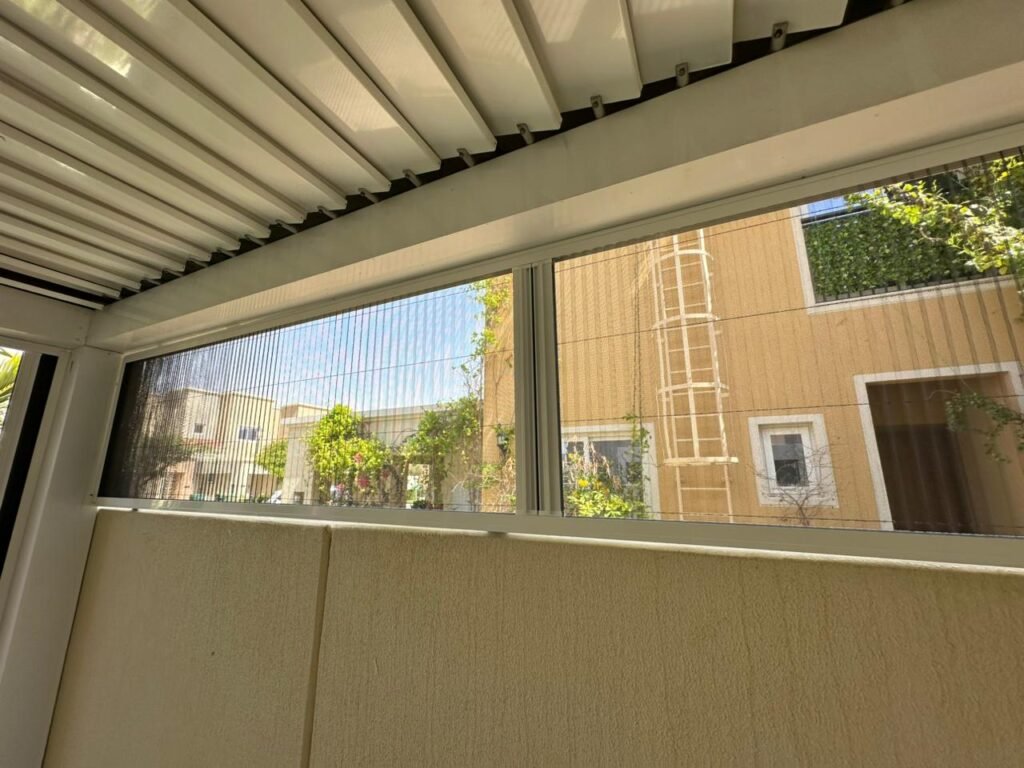
If you are not sure which system suits your windows, our comparison of every mosquito screen type available in Dubai walks through all eight with real fitted prices.
Then do the boring part. Walk your property once a month and tip out anything holding water. Check the AC tray. Check the irrigation boxes. Check the plant saucers. Given how fast Culex completes its cycle, a monthly walk-around genuinely breaks the generation.
Frequently asked questions
How many mosquito species are there in the UAE?
The largest published UAE survey trapped ten species across three sites in 2018. The national list is longer than that, since a survey only records what its traps catch, but ten species in a single study gives a fair picture of what is common. Only three are regular human biters.
Do mosquitoes in Dubai carry malaria?
No. The UAE has been certified malaria-free by WHO since 2007. Anopheles mosquitoes capable of carrying malaria elsewhere have been recorded in the country, but local transmission does not occur and the health authorities monitor for imported cases.
Why do I get bitten indoors at night but my partner does not?
Mosquitoes locate hosts by carbon dioxide, body heat and skin chemistry, and those vary between people. What does not vary is the entry point. If bites are happening indoors at night, Culex quinquefasciatus is getting in through a specific unscreened opening, and closing that opening helps both of you.
Will a mosquito screen stop all four of these species?
Yes. All four are ordinary-sized mosquitoes and none can pass standard insect mesh. Screens fail for installation reasons, not mesh reasons: gaps at the frame edge, a door that does not self-close, or a torn panel nobody replaced.
Is the mosquito problem in the UAE getting worse?
Two things are changing. Heavier and less predictable rainfall creates breeding habitat that did not exist before, which UAE authorities noted after the spring 2026 rains. And pyrethroid resistance is now present across sampled Culex quinquefasciatus populations in Abu Dhabi, which makes chemical control less reliable over time. Neither change affects how well a physical barrier works.
Where should I report a mosquito breeding site in the UAE?
The Ministry of Climate Change and Environment takes reports of stagnant water and high mosquito activity on 8003050. In Dubai, pest control requests can be raised through the DubaiNow app.
The practical takeaway
Three mosquitoes matter to you in the UAE. One comes indoors at night and breeds in dirty water close to your building. One breeds in coastal salt marsh kilometres away and flies in to bite you outdoors at dusk. One is everywhere and mostly ignores you. A fourth, Aedes aegypti, is the one worth staying informed about.
All of them are stopped by the same thing: a properly fitted mesh over the openings you actually use. We measure and fit across Dubai, Abu Dhabi, Sharjah and the northern emirates, and the measurement is free. See where we cover or book a free measurement.
Sources
- Mosquito biodiversity and mosquito-borne viruses in the United Arab Emirates, Parasites & Vectors, 2019.
- The southern house mosquito Culex quinquefasciatus in Abu Dhabi, UAE, is developing resistance to deltamethrin insecticide, Scientific Reports, 2025.
- Detection of Dengue Virus in Aedes aegypti Mosquitoes, Dubai, United Arab Emirates, Emerging Infectious Diseases, CDC, August 2026.
- World Health Organization, Dengue and severe dengue.
- World Health Organization, West Nile virus.
- UAE Ministry of Health and Prevention, 16 years of a malaria-free UAE.
- Walter Reed Biosystematics Unit, Smithsonian Institution, Aedes caspius species page.
- Texas A&M AgriLife, Culex quinquefasciatus.